
You have an idea for a new genetic test but need lab know-how to make it real? Novogenia supports you as a development partner: from selecting the markers through panel design and assay development to validation. With more than 30 self-developed genetic tests and our own EU genetic lab, we know how a hypothesis becomes a market-ready product.
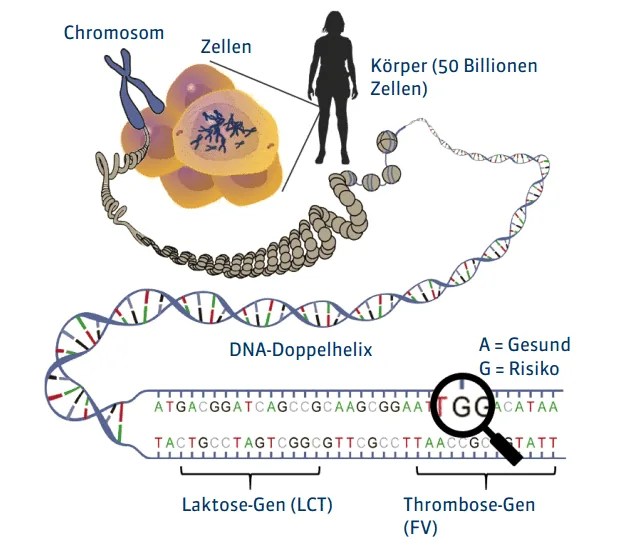
Together we define the research question and select the genetic markers that make your product scientifically sound.
We design your genetic test's marker panel — precisely balanced for informative value, throughput and cost-efficiency.
Development and optimization of the analysis assay in our own lab, until sensitivity and specificity meet your requirements.
Structured validation of reproducibility and robustness, so that your genetic test delivers reliable, dependable results.
From a pilot run with a small number of samples to scalable routine production at high throughput — all in the same lab.
On request, the analysis becomes a finished product including report and findings under your own brand.
We have developed more than 30 of our own genetic tests — that practice flows directly into your development project instead of starting from scratch.
Assay development, validation and later production run in the same EU genetic lab — short paths instead of scattered responsibilities.
We design the marker panel precisely for your research question — not an off-the-shelf solution, but a perfectly fitted product.
Reproducibility and robustness are tested in a structured way, so that your genetic test delivers dependable results you can rely on.
What we develop can be transferred to high throughput in-house — the leap from pilot to series doesn't get left to you.
Whether joint product development or pure contract development — we tailor the cooperation to your goal and your pace.
A good idea for a genetic test is only the beginning. Turning it into a reliable product takes panel design, assay development and clean validation. This is exactly where Novogenia comes in: we combine scientific experience with our own EU genetic lab — and then transfer what we develop straight into high-throughput production. That way your project stays in one hand, from the idea to the series.
Start development →To develop a genetic test means turning a scientific research question into a reliable analytical method. This includes selecting the relevant genetic markers, the panel design, the assay development and the validation of the finished method.
As a development partner, Novogenia accompanies this path in its own EU genetic lab — from the first idea to the market-ready product. More than 30 self-developed genetic tests form the basis of experience. This wealth of experience shortens the path considerably, because many questions on which newcomers lose time are already answered with us — from the choice of method to the typical pitfalls of a new genetic analysis.
At the start of every new genetic analysis is the question of which genetic markers actually carry informative value. Not every interesting marker is also suitable for a marketable product — what matters is the combination of scientific evidence and practical measurability.
In panel design we combine the selected markers into a coherent set that is both scientifically sound and economically producible. A good panel balances informative value, throughput and cost — and forms the foundation on which the later assay development is built. If the panel is too small, informative value is lacking; if it's too large, cost-efficiency and throughput suffer. Striking this balance is a matter of experience.
Assay development translates the panel into a working laboratory method. In our own EU genetic lab we develop and optimize the assay until sensitivity and specificity meet your requirements.
Because development and later production sit in the same house with us, no friction losses arise at interfaces — what is developed in the lab can also be manufactured reproducibly there. That is a key difference from setups where a method is developed at one service provider and produced at another: such handovers cost time and carry the risk that an assay that works on a small scale fails to deliver on its promise in routine operation.
A genetic test is only as good as its validation. What gets tested includes reproducibility, robustness and the reliability of the results across different runs, batches and conditions.
Only clean validation ensures that your product delivers dependable results — the foundation for the trust of your customers and partners. A genetic test that delivers a wrong result even once damages confidence in an entire brand. Novogenia therefore approaches this step in a structured way instead of skipping it. Validation is not a tedious formality at the end, but the proof that your method does in real operation what it was developed to do.
Many development projects fail not on the idea but on the leap from the pilot phase into series. A method that works with a few samples in the lab first has to prove itself in routine operation at high throughput.
At Novogenia this transition is part of the plan: after a pilot run with a manageable number of samples, we transfer the validated test straight into high-throughput production in our own lab. That keeps the path from hypothesis to scalable routine in one continuous chain — without you having to search for a suitable production partner after development and hand the method over a second time.
How close the cooperation is, is up to you. In joint product development, each side contributes its strengths and shares idea and execution — you the market and application knowledge, we the lab and method expertise.
In pure contract development, you supply the specification and we develop the genetic test to your requirements. In both cases you benefit from a partner that unites science, lab and production — and, on request, delivers the finished product under your brand. Which model fits depends on how much you want to contribute yourself and how mature your idea already is. Both paths lead to a production-ready, validated method.
There is no blanket duration — it depends on the complexity of the panel design, the number of markers, the effort of the assay development and the scope of the validation. A targeted test with few, well-described markers is implemented faster than an extensive panel that is meant to cover many variants at once.
What's decisive for a realistic timeframe is a clearly defined project scope. That's why every development project at Novogenia begins with clean scoping: together we clarify the research question, the desired informative value and the framework conditions before we draw up a plan with milestones. Because development, validation and production sit in the same house with us, the waiting times that arise when handing over between several service providers are eliminated — which noticeably shortens the path from the idea to the finished genetic test.
Novogenia has been active as a genetic lab since 2009 and has developed more than 30 of its own genetic tests — with its own, certified EU genetic lab in Salzburg. This combination of scientific experience, development expertise and production capacity makes us a reliable development partner for new genetic-analysis products.
From panel design through assay development to validation and later series production, your project stays in one hand. That saves handovers, accelerates development and reduces the risk of something getting lost between several service providers. Discuss your development project now, with no obligation or ask our AI assistant directly.
Tell us about your idea — we'll get back to you with an assessment of marker selection, panel design and the path to validation. Or ask our AI assistant directly, around the clock.