
Aging is not a single event but a series of processes running in parallel in each of your roughly 37 trillion cells. Modern research has decoded them. The Novogenia Longevity series addresses the six most important — each with its own carefully designed active-ingredient formula.
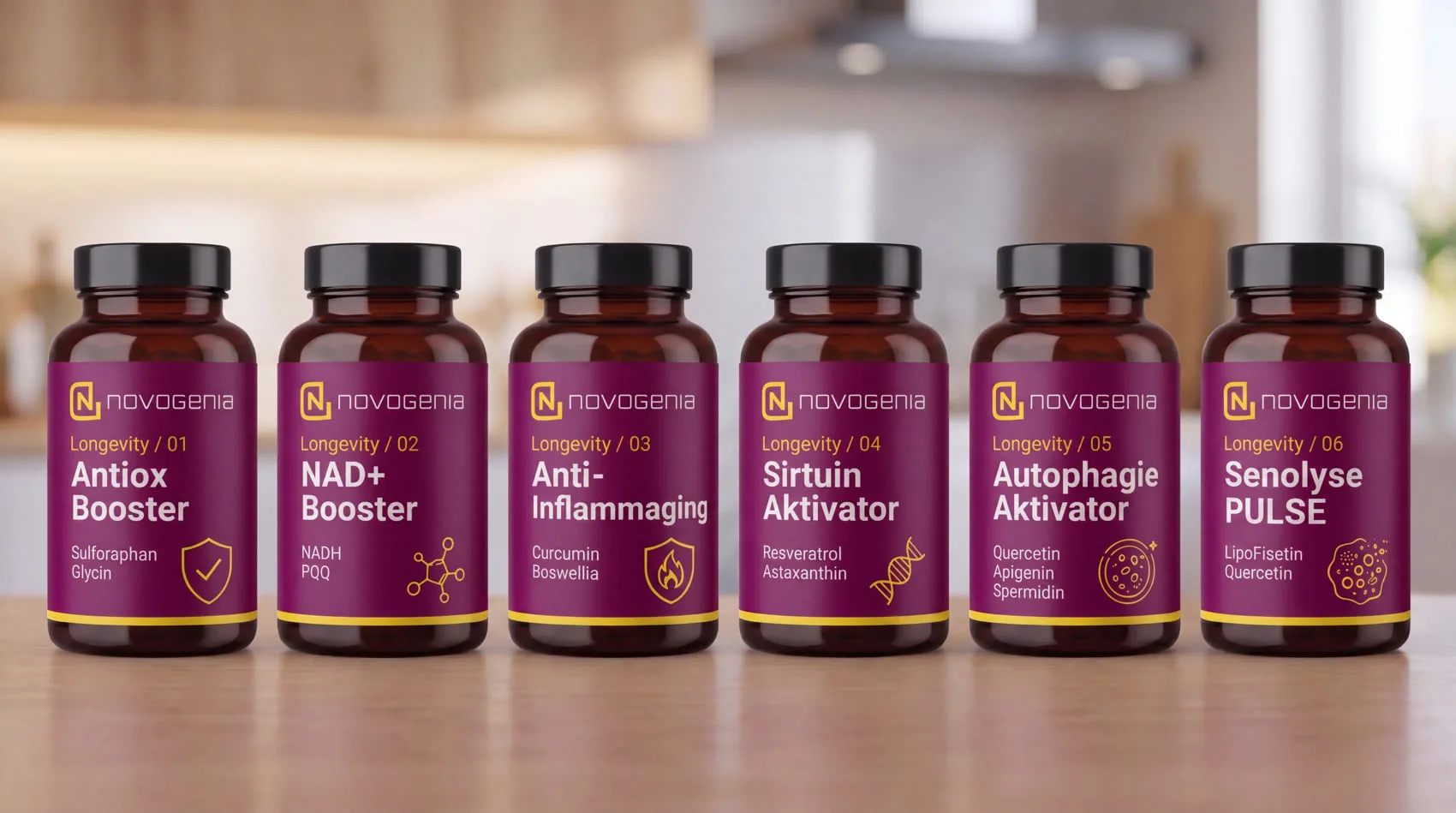
The honest answer is uncomfortable: our genes were never programmed to keep us alive forever. They are optimised to keep us healthy until reproduction — after that, the rules change.
That explains why we live in near-perfect health until about 30 — and why a slow decline sets in year after year thereafter. Over the past twenty years, research has decoded exactly these processes. Here are the six most important — and the product that addresses each.
Each process begins at a certain age — and each has its own Novogenia product. Tap a process for the details.
The building blocks start where each aging process measurably begins — from the Antiox Booster at 25 to the monthly Senolysis at 50.
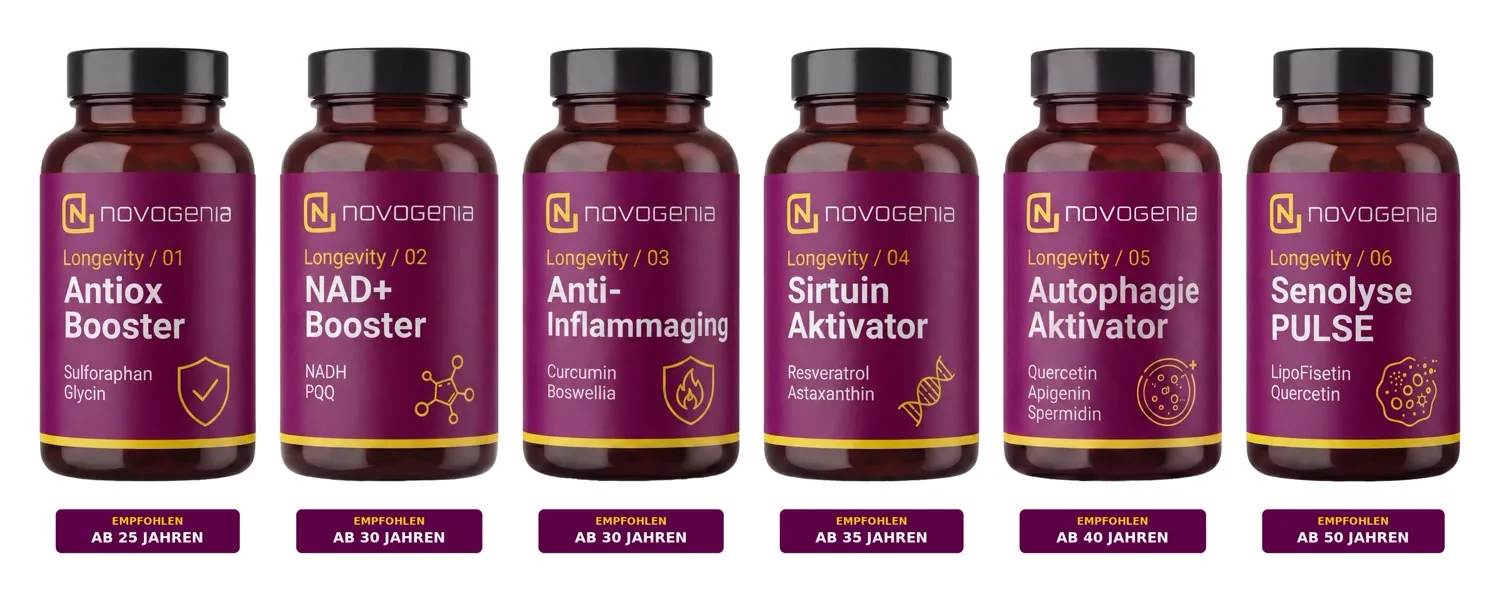
The six building blocks of the Longevity series with their respective age recommendation.
For each of the six formulas, our laboratory in Salzburg has produced its own scientific literature review — with a combined 90 referenced studies from PubMed. Tap a formula for the summary and sources.
Biotechnologist, molecular biologist and Managing Director of Novogenia — on the development of the six Longevity formulas, in his own words.
Because aging is not a single process. Anyone who claims otherwise hasn’t read the literature in twenty years. Modern research has clearly identified at least six different cellular processes running in parallel: oxidative stress, NAD+ loss, inflammaging, sirtuin dysfunction, autophagy loss and cellular senescence. Each of these processes needs different active ingredients, different dosages, sometimes different intake times.
We had two options: build a marketing bestseller with a colourful multivitamin pill that ignores the science. Or be honest and develop six targeted formulas that address what actually happens in the body. We chose the latter — even if it takes more explaining at the point of sale.
The question can’t be answered cleanly in that form — and that is an important point. The six processes are interconnected: oxidative stress drives inflammaging, which in turn damages mitochondria, which overloads autophagy, which leads to more senescent cells. They reinforce one another.
But if I had to prioritise, I would put oxidative stress first — it is the arsonist that feeds the other five processes. Still, the whole is more than the sum of its parts.
Because each of these processes becomes clinically relevant at a different stage of life. Taking active ingredients against a problem that does not yet exist makes neither physiological nor economic sense. In order of appearance:
Applying senolysis too early misses the target; applying the Antiox Booster too late pushes the start back unnecessarily.
Three criteria, in this order:
Personalised nutrients based on my genes and blood values. That ensures the right basic supply — exactly the vitamins, minerals and trace elements in the amounts my individual body needs, rather than a blanket multivitamin assumption.
There is no overlap with the Longevity line: the basic supply covers my daily micronutrient needs, the Longevity line addresses the six aging processes. Both can be taken in parallel and complement each other.
Deliberately not included are several substances from the US longevity scene (NMN, rapamycin, metformin) — either because their status as a food supplement in Europe is unclear or because they require a doctor’s prescription. Hype substances with thin evidence such as urolithin A or high-dose berberine are also not in it — for those we are waiting for more robust studies.
Soberly compared with the four most frequently cited voices:
Our line covers six processes instead of one or two — methodically broader than any single expert stack. Importantly: no serious researcher would say "take my stack and nothing else". It is about mechanisms, not brands.
Senescent cells behave differently from most other forms of aging damage. They accumulate slowly — over weeks to months. Once you clear them with a senolytic, the burden stays low for a long time before new ones accumulate.
Daily intake contradicts the pulse concept established in research and would influence normal cellular signalling pathways without necessity. Senolytics are not "more is more".
The pulse protocol — two consecutive days at a higher dose, then 28 days’ break — comes from the original Mayo Clinic senolysis research. This "hit-and-run" principle is what defines the entire senolytic class.
The simple version: all five daily building blocks at a fixed time — ideally with the main meal and some fat, typically breakfast or lunch. Pragmatically practical for everyday life.
The optimised version: staggered by time of day, because individual actives biologically fit certain phases better.
For most people the simple version is enough. For senolysis, however, the pulse protocol is non-negotiable — daily intake would negate the mechanism.
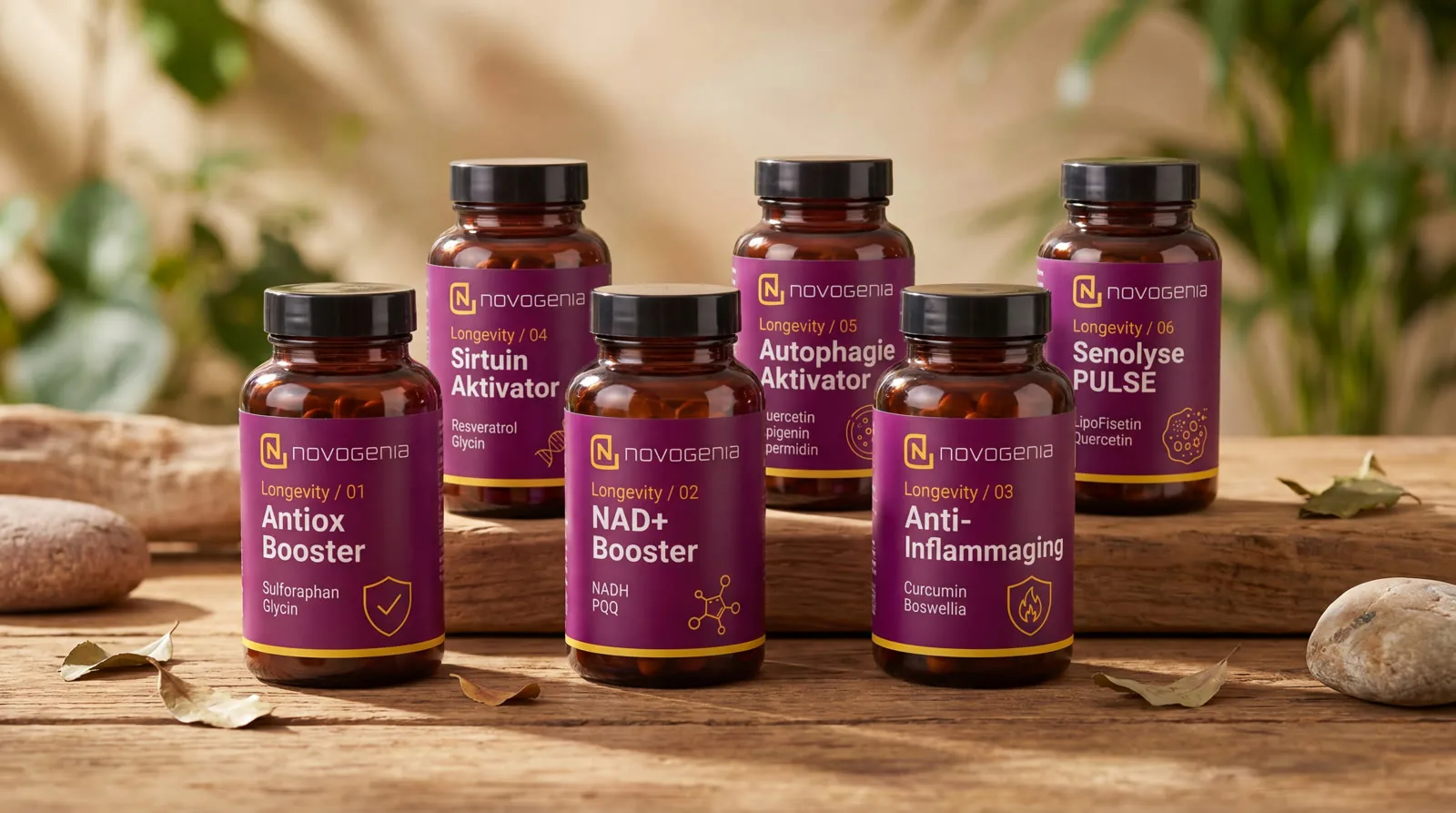
Six carefully designed formulas, developed and produced in our own EU laboratory in Salzburg. Available from 2026 as the Novogenia line and, on request, as a private-label product under your own brand. Secure your early access.
Become a partner →Dietary supplement: The Novogenia Longevity products are food supplements and not a substitute for a balanced, varied diet and a healthy lifestyle. Do not exceed the recommended daily intake. Keep out of the reach of young children. Coming 2026 — formulations, quantities and availability may still change before launch.
Science & recommendations: The aging processes described are the subject of modern biological research. The content presented here serves to inform about the active ingredients and their researched mechanisms and is to be understood as logical conclusions from this research — not as a promise of cure or statements on the prevention, treatment or healing of diseases. It does not replace medical advice, diagnosis or treatment.
Coming 2026 — get in touch to be among the first to hear about launch details and availability.